Joining Together Group Theory And Group Skills Ebook Free Download
Group piece of work: Using cooperative learning groups finer
Cite this guide: Brame, C.J. & Biel, R. (2015). Setting up and facilitating group work:
Using cooperative learning groups effectively. Vanderbilt University Center for Educational activity. Retrieved [todaysdate] from http://cft.vanderbilt.edu/guides-sub-pages/setting-upwardly-and-facilitating-group-work-using-cooperative-learning-groups-effectively/.
Many instructors from disciplines across the university utilise grouping work to enhance their students' learning. Whether the goal is to increment student understanding of content, to build detail transferable skills, or some combination of the 2, instructors often plough to small group piece of work to capitalize on the benefits of peer-to-peer instruction. This blazon of grouping work is formally termed cooperative learning, and is defined as the instructional utilise of small groups to promote students working together to maximize their own and each other's learning (Johnson, et al., 2008).
Cooperative learning is characterized by positive interdependence, where students perceive that better functioning past individuals produces better performance by the entire group (Johnson, et al., 2014). It can be formal or informal, but often involves specific instructor intervention to maximize pupil interaction and learning. It is infinitely adaptable, working in small and large classes and beyond disciplines, and can be one of the most effective teaching approaches available to college instructors.
- What tin can it wait like?
- What'southward the theoretical underpinning?
- Is there evidence that it works?
- What are approaches that can help make information technology constructive?
- References
What can it look like?
Informal cooperative learning groups
In breezy cooperative learning, pocket-size, temporary, ad-hoc groups of two to four students work together for brief periods in a class, typically upwards to one class menstruation, to answer questions or respond to prompts posed by the instructor.
Boosted examples of ways to structure informal group work
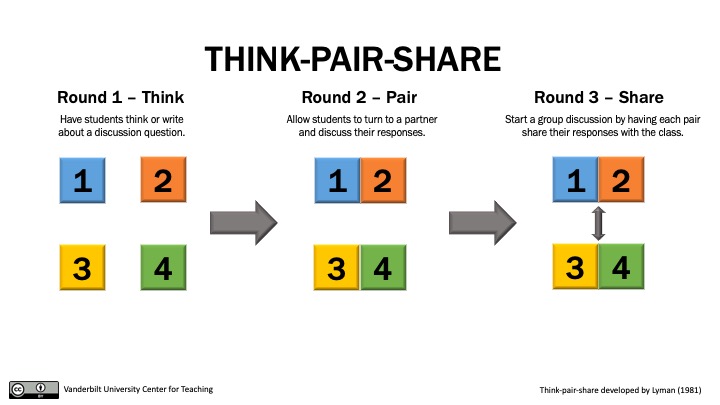
Think-pair-share
The instructor asks a discussion question. Students are instructed to remember or write well-nigh an answer to the question before turning to a peer to hash out their responses. Groups then share their responses with the class.
Peer Instruction
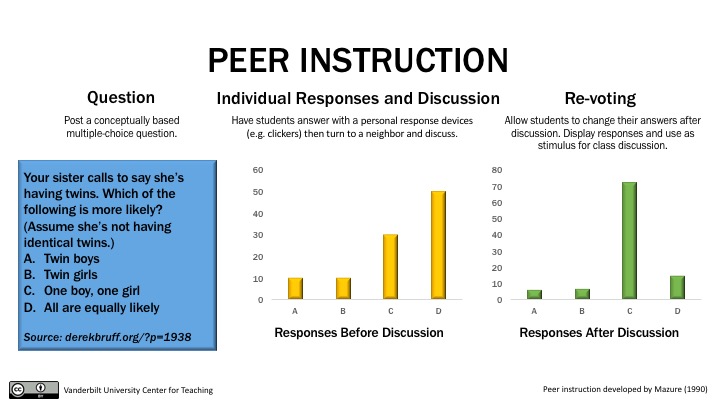
This modification of the think-pair-share involves personal responses devices (e.g. clickers). The question posted is typically a conceptually based multiple-selection question. Students call up nearly their respond and vote on a response before turning to a neighbor to discuss. Students tin change their answers later on discussion, and "sharing" is accomplished past the instructor revealing the graph of student response and using this equally a stimulus for large class discussion. This approach is particularly well-adapted for large classes.
Jigsaw
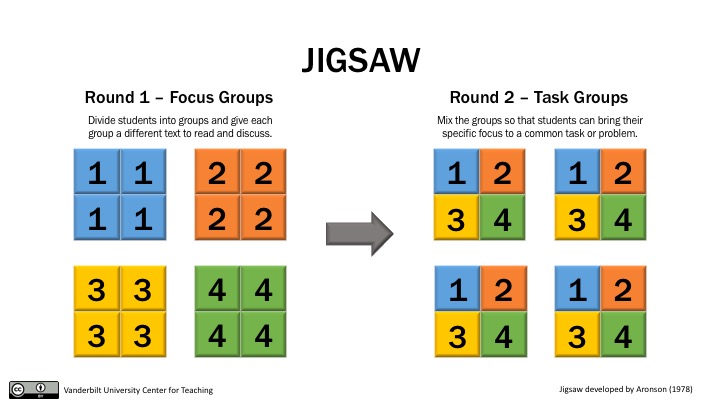
In this approach, groups of students work in a team of four to become experts on one segment of new material, while other "proficient teams" in the form work on other segments of new cloth. The class and then rearranges, forming new groups that have 1 member from each expert team. The members of the new team then accept turns educational activity each other the cloth on which they are experts.
Formal cooperative learning groups
In formal cooperative learning students work together for one or more class periods to complete a joint task or consignment (Johnson et al., 2014). There are several features that can help these groups work well:
- The instructor defines the learning objectives for the activity and assigns students to groups.
- The groups are typically heterogeneous, with particular attention to the skills that are needed for success in the chore.
- Inside the groups, students may be assigned specific roles, with the instructor communicating the criteria for success and the types of social skills that will be needed.
- Importantly, the instructor continues to play an active role during the groups' piece of work, monitoring the work and evaluating grouping and individual performance.
- Instructors besides encourage groups to reverberate on their interactions to identify potential improvements for future group work.
This video shows an example of formal cooperative learning groups in David Matthes' course at the University of Minnesota:
There are many more specific types of group work that fall under the general descriptions given hither, including team-based learning, problem-based learning, and process-oriented guided inquiry learning.
What'south the theoretical underpinning?
The use of cooperative learning groups in education is based on the principle of constructivism, with particular attending to the contribution that social interaction can make. In essence, constructivism rests on the idea that individuals learn through edifice their own cognition, connecting new ideas and experiences to existing cognition and experiences to form new or enhanced understanding (Bransford, et al., 1999). The consideration of the part that groups can play in this procedure is based in social interdependence theory, which grew out of Kurt Koffka's and Kurt Lewin's identification of groups as dynamic entities that could exhibit varied interdependence amidst members, with group members motivated to achieve common goals. Morton Deutsch conceptualized varied types of interdependence, with positive correlation amid grouping members' goal achievements promoting cooperation.
Lev Vygotsky extended this work by examining the relationship between cognitive processes and social activities, developing the sociocultural theory of evolution. The sociocultural theory of development suggests that learning takes place when students solve problems beyond their electric current developmental level with the support of their teacher or their peers. Thus both the idea of a zone of proximal development, supported by positive group interdependence, is the ground of cooperative learning (Davidson and Major, 2014; Johnson, et al., 2014).
Cooperative learning follows this idea as groups work together to larn or solve a problem, with each individual responsible for agreement all aspects. The pocket-sized groups are essential to this process considering students are able to both exist heard and to hear their peers, while in a traditional classroom setting students may spend more time listening to what the instructor says.
Cooperative learning uses both goal interdependence and resource interdependence to ensure interaction and communication among group members. Changing the role of the instructor from lecturing to facilitating the groups helps foster this social environment for students to learn through interaction.
Is there evidence that it works?
David Johnson, Roger Johnson, and Karl Smith performed a meta-analysis of 168 studies comparing cooperative learning to competitive learning and individualistic learning in college students (Johnson et al., 2006). They found that cooperative learning produced greater bookish achievement than both competitive learning and individualistic learning across the studies, exhibiting a mean weighted effect size of 0.54 when comparison cooperation and contest and 0.51 when comparison cooperation and individualistic learning. In essence, these results signal that cooperative learning increases student bookish operation by approximately one-half of a standard deviation when compared to non-cooperative learning models, an event that is considered moderate. Importantly, the academic achievement measures were divers in each study, and ranged from lower-level cognitive tasks (e.g., knowledge conquering and memory) to higher level cerebral activity (eastward.g., creative problem solving), and from verbal tasks to mathematical tasks to procedural tasks. The meta-analysis also showed substantial effects on other metrics, including cocky-esteem and positive attitudes nigh learning. George Kuh and colleagues also conclude that cooperative grouping learning promotes pupil engagement and bookish performance (Kuh et al., 2007).
Springer, Stanne, and Donovan (1999) confirmed these results in their meta-assay of 39 studies in academy Stem classrooms. They found that students who participated in various types of pocket-sized-group learning, ranging from extended formal interactions to brief informal interactions, had greater academic achievement, exhibited more favorable attitudes towards learning, and had increased persistence through Stalk courses than students who did not participate in Stem small-group learning.
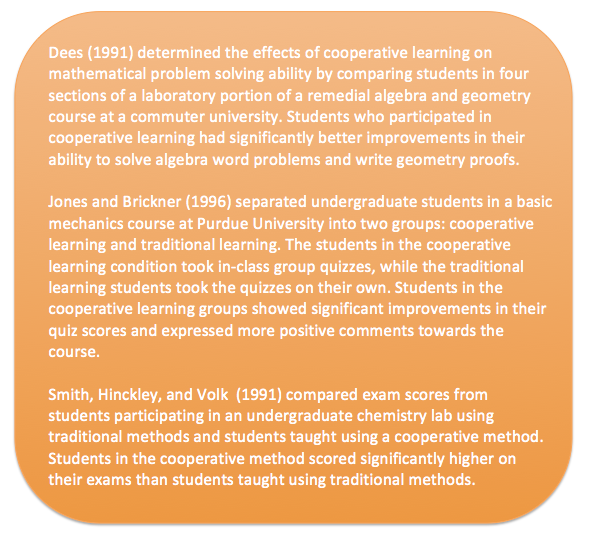
The box below summarizes 3 private studies examining the effects of cooperative learning groups.
What are approaches that can help make group work effective?
Preparation
Clear your goals for the group work, including both the bookish objectives you want the students to achieve and the social skills you desire them to develop.
Decide the group conformation that will help meet your goals.
- In informal group learning, groups often form ad hoc from near neighbors in a class.
- In formal group learning, it is helpful for the instructor to form groups that are heterogeneous with regard to particular skills or abilities relevant to group tasks. For example, groups may be heterogeneous with regard to academic skill in the discipline or with regard to other skills related to the group task (eastward.g., blueprint capabilities, programming skills, writing skills, organizational skills) (Johnson et al, 2006).
- Groups from 2-6 are generally recommended, with groups that consist of iii members exhibiting the all-time performance in some problem-solving tasks (Johnson et al., 2006; Heller and Hollabaugh, 1992).
- To avert common bug in grouping work, such as say-so by a single student or conflict abstention, it tin be useful to assign roles to group members (e.thou., manager, skeptic, educator, conciliator) and to rotate them on a regular ground (Heller and Hollabaugh, 1992). Assigning these roles is not necessary in well-functioning groups, just can exist useful for students who are unfamiliar with or unskilled at group work.
Choose an assessment method that volition promote positive group interdependence as well as individual accountability.
- In team-based learning, ii approaches promote positive interdependence and individual accountability. First, students take an individual readiness assessment examination, and so immediately take the same examination again as a grouping. Their grade is a composite of the two scores. 2d, students complete a group project together, and receive a group score on the project. They besides, however, distribute points amongst their group partners, allowing student cess of members' contributions to contribute to the final score.
- Heller and Hollabaugh (1992) describe an approach in which they incorporated group problem-solving into a class. Students regularly solved issues in small-scale groups, turning in a unmarried solution. In addition, tests were structured such that 25% of the points derived from a group problem, where simply those individuals who attended the group trouble-solving sessions could participate in the group exam problem. This arroyo can help forbid the "free rider" problem that can plague group work.
- The University of New Due south Wales describes a diverseness of means to appraise grouping work, ranging from shared group grades, to grades that are averages of individual grades, to strictly individual grades, to a combination of these. They also suggest ways to assess not but the product of the group work but also the procedure. Again, having a portion of a grade that derives from private contribution helps combat the gratis rider problem.
Helping groups become started
Explain the group'due south task, including your goals for their academic achievement and social interaction.
Explicate how the task involves both positive interdependence and private accountability, and how yous will be assessing each.
Assign group roles or give groups prompts to help them clear effective ways for interaction. The University of New South Wales provides a valuable set up of tools to help groups constitute adept practices when first meeting. The site as well provides some exercises for building group dynamics; these may be particularly valuable for groups that will be working on larger projects.
Monitoring group work
Regularly observe group interactions and progress, either by circulating during group work, collecting in-process documents, or both. When you observe problems, intervene to aid students move forwards on the task and work together effectively. The University of New South Wales provides handouts that instructors can apply to promote effective group interactions, such as a handout to assist students listen reflectively or give effective feedback, or to help groups identify detail problems that they may be encountering.
Assessing and reflecting
In improver to providing feedback on group and private functioning (link to preparation section to a higher place), it is also useful to provide a structure for groups to reflect on what worked well in their group and what could be improved. Graham Gibbs (1994) suggests using the checklists shown beneath.
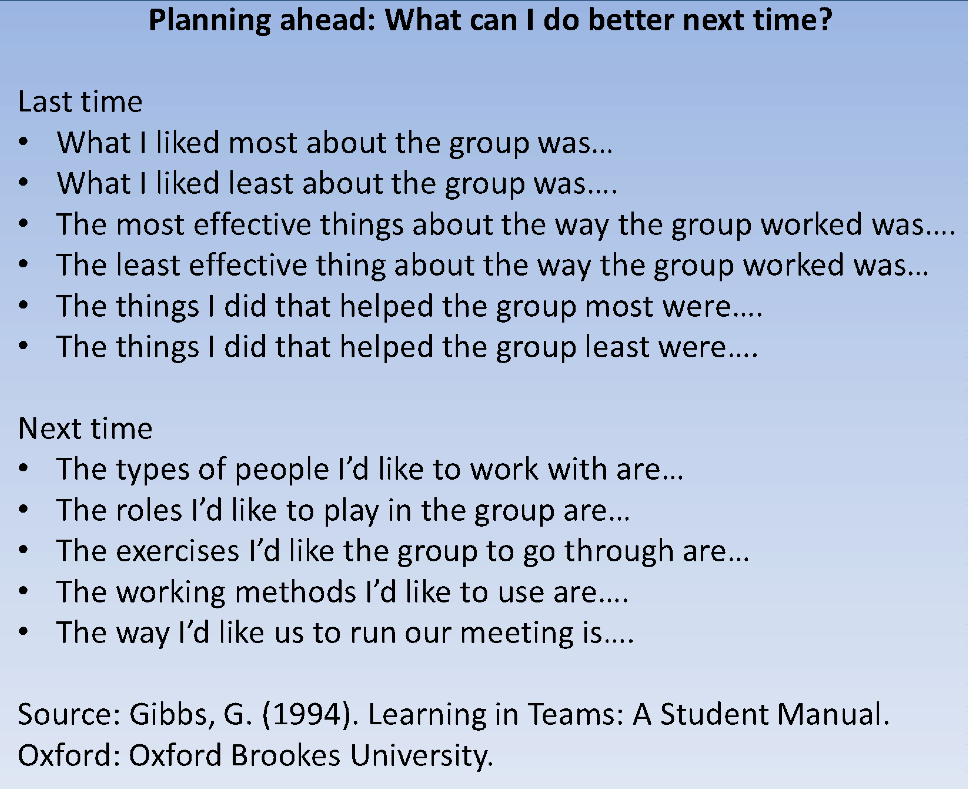
The University of New Due south Wales provides other reflective activities that may aid students place effective group practices and avoid ineffective practices in future cooperative learning experiences.
References
Bransford, J.D., Brown, A.L., and Cocking, R.R. (Eds.) (1999). How people larn: Brain, mind, experience, and schoolhouse. Washington, D.C.: National University Press.
Bruffee, Chiliad. A. (1993). Collaborative learning: College didactics, interdependence, and the authority of knowledge. Baltimore, Doc: Johns Hopkins University Press.
Cabrera, A. F., Crissman, J. L., Bernal, E. M., Nora, A., Terenzini, P. T., & Pascarella, E. T. (2002). Collaborative learning: Its impact on college students' development and diverseness. Journal of College Student Development, 43(1), 20-34.
Davidson, N., & Major, C. H. (2014). Boundary crossing: Cooperative learning, collaborative learning, and problem-based learning. Journal on Excellence in Higher Education, 25 (3&four), 7-55.
Dees, R. L. (1991). The role of cooperative leaning in increasing problem-solving ability in a higher remedial course. Periodical for Inquiry in Mathematics Education, 22(5), 409-21.
Gokhale, A. A. (1995). Collaborative Learning enhances disquisitional thinking. Periodical of Technology Pedagogy, 7(1).
Heller, P., and Hollabaugh, M. (1992) Pedagogy trouble solving through cooperative grouping. Part 2: Designing bug and structuring groups. American Journal of Physics lx, 637-644.
Johnson, D.Westward., Johnson, R.T., and Smith, K.A. (2006). Active learning: Cooperation in the university classroom (3rd edition). Edina, MN: Interaction.
Johnson, D.West., Johnson, R.T., and Holubec, E.J. (2008). Cooperation in the classroom (8th edition). Edina, MN: Interaction.
Johnson, D.W., Johnson, R.T., and Smith, Yard.A. (2014). Cooperative learning: Improving university instruction by basing do on validated theory. Journl on Excellence in College Teaching 25, 85-118.
Jones, D. J., & Brickner, D. (1996). Implementation of cooperative learning in a large-enrollment basic mechanics course. American Society for Engineering Education Annual Conference Proceedings.
Kuh, G.D., Kinzie, J., Buckley, J., Bridges, B., and Hayek, J.C. (2007). Piecing together the pupil success puzzle: Research, propositions, and recommendations (ASHE Higher Educational activity Report, No. 32). San Francisco, CA: Jossey-Bass.
Love, A. G., Dietrich, A., Fitzgerald, J., & Gordon, D. (2014). Integrating collaborative learning inside and exterior the classroom. Periodical on Excellence in College Teaching, 25(3&iv), 177-196.
Smith, M. E., Hinckley, C. C., & Volk, G. L. (1991). Cooperative learning in the undergraduate laboratory. Journal of Chemical Education 68(5), 413-415.
Springer, L., Stanne, Grand. E., & Donovan, S. Southward. (1999). Effects of small-group learning on undergraduates in science, mathematics, engineering, and technology: A meta-analysis. Review of Educational Enquiry, 96(1), 21-51.
Uribe, D., Klein, J. D., & Sullivan, H. (2003). The effect of computer-mediated collaborative learning on solving sick-defined problems. Educational Technology Research and Development, 51(1), 5-19.
Vygotsky, L. S. (1962). Thought and Language. Cambridge, MA: MIT Press.
Vygotsky, L. Due south. (1978). Mind in club. Cambridge, MA: Harvard Academy Press.

This pedagogy guide is licensed under a Creative Commons Attribution-NonCommercial four.0 International License.
DOWNLOAD HERE
Posted by: moorethereatend.blogspot.com